

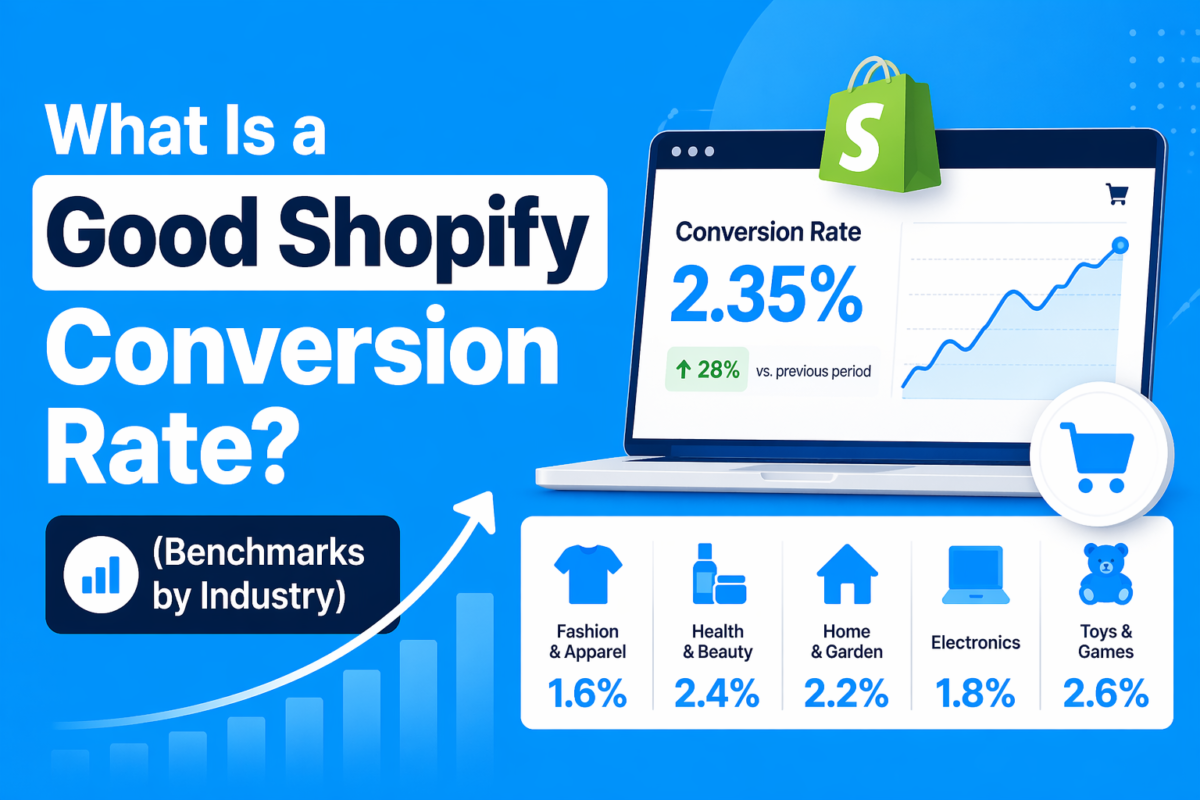
A “good” Shopify conversion rate is often said to be 2%–3%.
But that number on its own doesn’t tell you much.
A store converting at 1% with cold paid traffic can be performing well. Another store converting at 5% might still struggle if it relies only on returning visitors or heavy discounts. Product price, traffic quality, and brand maturity all play a major role in how conversion rates behave.
That’s why conversion rate isn’t a fixed benchmark—it’s a context-driven metric.
To understand whether your store is performing well, you need to look at conversion rate through multiple lenses: your industry, your traffic sources, your stage of growth, and the type of products you sell.
In this guide, you’ll see what a good Shopify conversion rate actually looks like—broken down by industry, traffic source, store stage, and product price. You’ll also learn how to evaluate your own numbers correctly and identify where you can improve.
By the end, you’ll have a clear, practical framework to understand where your store stands—and what to do next.
Table Of Contents
- What Is a Shopify Conversion Rate? (Quick Definition)
- Why Most Conversion Rate Advice Is Misleading
- Shopify Conversion Rate Benchmarks (The Real Data)
- What Is a Good Shopify Conversion Rate? (Real Answer)
- When a “Low” Conversion Rate Is Actually Good
- When a “High” Conversion Rate Is Misleading
- Why Your Shopify Store Isn’t Converting (Root Causes)
- How to Improve Your Shopify Conversion Rate (That Actually Works)
- Key Metrics to Track Alongside Conversion Rate
- Conclusion
- FAQ: Shopify Conversion Rates
What Is a Shopify Conversion Rate? (Quick Definition)
Your Shopify conversion rate is the percentage of visitors who take a desired action on your store—most commonly, making a purchase.
In simple terms, it answers one question:
Out of everyone who visits your store, how many actually buy?
The Formula
Conversion rate is calculated like this:
Conversion Rate = (Number of Orders ÷ Number of Visitors) × 100
Simple Example
- 1,000 people visit your store
- 20 people make a purchase
Your conversion rate = 2%
Why It Matters
Conversion rate is one of the most important metrics in ecommerce because it directly reflects how well your store turns traffic into revenue.
- High traffic + low conversion = wasted potential
- Low traffic + high conversion = strong efficiency
- High traffic + high conversion = scalable growth
Important Context
Conversion rate doesn’t exist in isolation.
It’s influenced by:
- The quality of your traffic
- The intent of your visitors
- Your product pricing and positioning
- Your store’s overall trust and user experience
That’s why looking at the number alone isn’t enough—you need to evaluate it within the right context, which we’ll break down next.
Why Most Conversion Rate Advice Is Misleading
Conversion rate is often treated like a fixed benchmark—a single number you should aim for.
In reality, that approach leads to wrong conclusions.
One Number Doesn’t Tell the Full Story
A conversion rate like 2% or 3% might sound clear, but without context, it doesn’t mean much.
The same number can represent completely different situations:
- A 2% conversion rate from high-intent organic traffic may indicate underperformance
- A 2% conversion rate from cold paid ads could be strong
The number itself isn’t the problem—the lack of context is.
Not All Traffic Is Equal
Visitors don’t arrive at your store with the same intent.
- Someone clicking an ad for the first time is still evaluating
- Someone coming from email already trusts your brand
- A returning visitor is far more likely to convert
When different types of traffic are grouped into a single conversion rate, the result becomes misleading.
Product Type Changes Everything
Conversion behavior shifts depending on what you’re selling.
- Low-priced, impulse products convert quickly
- Expensive or considered purchases take time and multiple visits
A store selling a $20 product and a store selling a $500 product should not expect similar conversion rates.
Store Stage Matters
A new store and an established brand operate under very different conditions.
- New stores lack trust, reviews, and brand recognition
- Established stores benefit from returning customers and social proof
Comparing both under the same benchmark creates unrealistic expectations.
Conversion Rate Alone Can Be Misleading
Focusing only on conversion rate can hide what’s actually happening in your business.
For example:
- A high conversion rate with low traffic won’t scale
- A lower conversion rate with strong traffic and high order value can be more profitable
That’s why conversion rate should always be evaluated alongside other factors like traffic quality and revenue per visitor.
The Right Way to Think About It
Conversion rate isn’t a universal target—it’s a relative performance metric.
To understand whether your number is good or not, you need to evaluate it based on:
- Where your traffic comes from
- What you’re selling
- How established your store is
Once you look at it this way, the numbers start to make sense—and become much more useful.
Shopify Conversion Rate Benchmarks (The Real Data)
To understand what a “good” conversion rate looks like, you need to look at benchmarks from multiple angles—not just a single average.
Here’s how conversion rates actually break down across different contexts.
Overall Benchmarks
At a broad level, most Shopify stores fall into these ranges:
- 1% – 3% → Average
- 3% – 5% → Good
- 5%+ → Top-performing stores
These ranges give you a general reference point, but they don’t explain why numbers vary. That becomes clear when you break things down further.
Benchmarks by Industry
Different industries convert at different rates due to pricing, buying behavior, and urgency.
| Industry | Typical Conversion Rate |
|---|---|
| Fashion & Apparel | 1% – 3% |
| Electronics | 1% – 2% |
| Health & Beauty | 2% – 4% |
| Home & Furniture | 1% – 2.5% |
| Food & Beverage | 3% – 5% |
| Luxury Products | 0.5% – 1.5% |
Key insight:
- Everyday, low-cost products tend to convert higher
- Expensive or research-heavy products convert lower
Benchmarks by Traffic Source
Not all visitors behave the same. Conversion rates change significantly depending on where your traffic comes from.
- Cold paid traffic (ads) → 0.5% – 2%
- Organic traffic (search, SEO) → 2% – 4%
- Email / returning visitors → 4% – 10%
Key insight:
Traffic with higher intent and trust converts better. Someone discovering your store for the first time behaves very differently from someone already familiar with your brand.
Benchmarks by Store Stage
Your store’s level of maturity plays a major role in performance.
- New store → 0.5% – 2%
- Growing store → 2% – 4%
- Established brand → 4% – 8%+
Key insight:
As your brand builds trust, collects reviews, and attracts returning customers, conversion rates naturally improve.
Benchmarks by Product Price (AOV)
Product pricing directly influences how easily customers convert.
- Low-ticket products → 3% – 6%
- Mid-ticket products → 2% – 4%
- High-ticket products → 0.5% – 2%
Key insight:
Higher prices increase hesitation and decision time, which lowers conversion rate—but often increases revenue per customer.
What These Benchmarks Really Show
There is no single “correct” conversion rate.
A number only becomes meaningful when you compare it within the right context:
- Your industry
- Your traffic sources
- Your pricing
- Your stage of growth
Once you evaluate your store using these benchmarks together, you get a much clearer and more accurate picture of performance.
What Is a Good Shopify Conversion Rate? (Real Answer)
A good Shopify conversion rate is not a fixed number—it’s a range that only makes sense in context.
Looking at benchmarks alone can be misleading unless you interpret them correctly. What actually matters is how your store performs relative to the key factors that influence conversion: traffic quality, product pricing, and brand maturity.
A Practical Benchmark Framework
Instead of chasing a single number, use this simple framework:
- Below 1% → Likely underperforming (in most cases)
- 1% – 3% → Within the typical range
- 3% – 5% → Strong performance
- 5%+ → Top-tier performance
This gives you a quick way to position your store—but it’s only the starting point.
Context Changes Everything
The same conversion rate can mean very different things depending on your situation.
- A lower conversion rate can still be healthy if you’re driving cold traffic or selling higher-priced products
- A higher conversion rate doesn’t always mean strong performance if it comes from limited or highly warmed-up traffic
That’s why conversion rate should always be interpreted alongside how your business operates, not in isolation.
What You Should Actually Focus On
Instead of aiming for a universal benchmark, focus on:
- Improving your conversion rate over time
- Comparing performance within your own traffic and pricing structure
- Identifying where you’re losing potential customers in your funnel
Progress matters more than hitting an arbitrary number.
Key Takeaway
A good Shopify conversion rate is one that reflects efficient use of your traffic and steady improvement over time.
Once you stop treating conversion rate as a fixed target and start using it as a performance indicator, it becomes far more useful—and actionable.
When a “Low” Conversion Rate Is Actually Good
A low conversion rate isn’t always a problem.
In many cases, it’s a natural outcome of how your business operates—especially when you’re prioritizing growth, reaching new audiences, or selling higher-value products.
Here are situations where a lower conversion rate can still indicate healthy performance.
You’re Driving Cold Traffic
If most of your visitors are discovering your store for the first time, a lower conversion rate is expected.
Cold traffic:
- Doesn’t know your brand
- Has lower trust
- Needs more time to decide
In this case, conversion rates in the 0.5%–2% range can still be solid—especially if your traffic is well-targeted and generating sales consistently.
You Sell High-Ticket Products
Higher-priced products naturally reduce conversion rates.
Customers:
- Spend more time researching
- Compare alternatives
- Often don’t buy on the first visit
A store selling $300–$1,000 products will almost always convert lower than one selling $20–$50 items. Lower conversion doesn’t mean poor performance—it often comes with higher revenue per order.
You’re in the Early Stage
New stores typically convert lower because they lack:
- Customer reviews
- Brand recognition
- Returning visitors
A conversion rate under 2% can be completely normal in the early phase, as long as the store is improving over time and starting to generate consistent sales.
You’re Focused on Scaling Traffic
When you aggressively increase traffic—especially through paid ads—conversion rate often drops.
Why?
- You’re reaching a broader audience
- Not all visitors are high-intent
- You’re testing new segments
This trade-off is normal. In many cases, a slightly lower conversion rate is acceptable if overall revenue is growing.
You’re Optimizing for Revenue, Not Just Conversion
A lower conversion rate doesn’t always mean lower performance.
For example:
- Fewer customers buying higher-value products can generate more revenue
- A store with 1.5% conversion and high order value can outperform a store with 4% conversion and low order value
This is why conversion rate should always be evaluated alongside metrics like revenue per visitor and average order value.
Key Takeaway
A “low” conversion rate is only a problem when it reflects lost opportunities—not when it reflects your business model.
If your traffic is growing, your revenue is increasing, and your numbers make sense for your context, a lower conversion rate can still be a sign that your store is on the right track.
When a “High” Conversion Rate Is Misleading
A high conversion rate looks great on the surface—but it doesn’t always mean your store is performing well.
In some cases, it can give a false sense of success while hiding bigger problems.
You Have Low Traffic Volume
A high conversion rate with very little traffic doesn’t tell you much.
For example:
- 50 visitors → 5 purchases = 10% conversion rate
That looks impressive, but the sample size is too small to be reliable. A few extra purchases—or a few fewer—can swing the number dramatically.
Without consistent traffic, conversion rate becomes unstable and less meaningful.
You Rely Heavily on Returning Customers
Returning visitors and loyal customers convert at much higher rates.
If most of your sales come from:
- Email campaigns
- Direct traffic
- Repeat buyers
Your conversion rate may look high—but it doesn’t reflect how well you attract and convert new customers.
This can limit your ability to scale.
You Depend on Heavy Discounts
Aggressive discounts can boost conversion rate quickly.
But there’s a trade-off:
- Lower profit margins
- Reduced perceived value
- Customers trained to wait for deals
A high conversion rate driven by constant discounting may not be sustainable long-term.
Your Traffic Is Too Narrow
Highly targeted or small audiences can produce strong conversion rates.
For example:
- Retargeting campaigns
- Branded search traffic
These audiences already have intent and familiarity, so they convert easily. But relying only on these segments limits growth potential.
You’re Ignoring Revenue Metrics
A high conversion rate doesn’t automatically mean strong business performance.
For example:
- Selling low-priced products with high conversion may generate less revenue
- A store with slightly lower conversion but higher order value can outperform it
This is why metrics like average order value (AOV) and revenue per visitor (RPV) matter just as much.
Key Takeaway
A high conversion rate is only valuable if it comes with:
- Scalable traffic
- Sustainable margins
- Strong overall revenue
Without these, the number can be misleading.
The goal isn’t just to maximize conversion rate—it’s to build a store that grows profitably and consistently.
Why Your Shopify Store Isn’t Converting (Root Causes)
If your store is getting traffic but not generating enough sales, the issue usually isn’t random—it comes down to a few core problems.
Instead of guessing, it’s more effective to diagnose conversion issues in structured categories.
1. Traffic Problems (Wrong People, Wrong Intent)
Not all traffic is valuable.
If your visitors aren’t the right audience or don’t have buying intent, they won’t convert—no matter how good your store looks.
Common issues:
- Targeting broad or irrelevant audiences
- Misaligned ads (clickbait vs actual product)
- Low-intent traffic from untargeted campaigns
What it leads to:
High bounce rates, low engagement, and weak conversion.
2. Lack of Trust
People don’t buy from stores they don’t trust.
If your store feels unfamiliar, unclear, or risky, visitors hesitate—even if they like the product.
Common issues:
- No customer reviews or testimonials
- Weak branding or inconsistent design
- Missing trust signals (secure checkout, policies, contact info)
What it leads to:
Visitors leave without taking action, even with strong traffic.
3. Poor User Experience (UX/UI)
Even small friction points can reduce conversions significantly.
If your store is slow, confusing, or hard to navigate, users drop off quickly.
Common issues:
- Slow loading speed
- Cluttered layout or poor design hierarchy
- Bad mobile experience
What it leads to:
Frustration, drop-offs, and abandoned sessions.
4. Weak Product Pages
Your product page is where buying decisions happen.
If it doesn’t clearly communicate value, visitors won’t convert.
Common issues:
- Low-quality or insufficient images
- Generic or unclear product descriptions
- Weak or missing call-to-action (CTA)
What it leads to:
Interest without action—people browse but don’t buy.
5. Checkout Friction
Even when customers are ready to buy, a complicated checkout can stop them.
Common issues:
- Too many steps in the checkout process
- Forced account creation
- Limited payment options
What it leads to:
Cart abandonment at the final stage.
6. Mismatch Between Expectations and Reality
When your marketing promise doesn’t match the actual product or page experience, conversions drop.
Common issues:
- Ads that overpromise
- Landing pages that don’t match the ad message
- Misleading product positioning
What it leads to:
Visitors lose trust immediately and leave.
Key Takeaway
Low conversion rates are rarely caused by a single issue.
In most cases, it’s a combination of:
- Traffic quality
- Trust level
- User experience
- Offer clarity
The key is to identify where the biggest friction exists and fix that first. Once you remove the major barriers, conversion rates tend to improve naturally.
How to Improve Your Shopify Conversion Rate (That Actually Works)
Improving your Shopify conversion rate isn’t about chasing gimmicks—it’s about removing friction, building trust, and guiding visitors to buy.
Here’s a practical framework that focuses on what actually moves the needle.
1. Optimize Your Product Pages
Your product page is where the sale happens. Strong product pages can dramatically increase conversions.
Actionable improvements:
- Use high-quality images and videos showing the product in use
- Write clear, persuasive descriptions highlighting benefits, not just features
- Add strong call-to-actions (CTAs) like “Buy Now” or “Add to Cart”
- Include trust signals: reviews, ratings, and social proof
2. Simplify the Checkout Process
Even interested customers abandon carts when checkout is complicated.
Actionable improvements:
- Reduce the number of steps in checkout
- Allow guest checkout
- Offer multiple payment options (cards, PayPal, Apple Pay, etc.)
- Clearly display shipping costs and return policies
3. Improve User Experience (UX/UI)
A smooth shopping experience keeps visitors engaged and encourages them to buy.
Actionable improvements:
- Ensure your store is fast-loading
- Optimize for mobile devices
- Keep navigation simple and intuitive
- Highlight key actions visually (buttons, links, banners)
4. Build Trust and Credibility
People buy from brands they trust. Without trust, even the best product won’t convert.
Actionable improvements:
- Display customer reviews and testimonials prominently
- Include security badges and clearly visible policies
- Maintain consistent branding and professional design
5. Target the Right Traffic
High-quality traffic converts better than high volume traffic.
Actionable improvements:
- Focus on audiences that match your product
- Retarget visitors who showed interest but didn’t buy
- Use email campaigns to nurture returning customers
6. Test, Measure, and Iterate
Conversion rate optimization is a continuous process.
Actionable improvements:
- Run A/B tests on headlines, product pages, and CTAs
- Track metrics like conversion rate, average order value, and revenue per visitor
- Make changes based on data, not guesswork
Key Takeaway
There’s no single trick to skyrocketing conversions. The stores that grow consistently focus on high-impact improvements: optimizing product pages, simplifying checkout, building trust, targeting the right audience, and continuously testing.
When you systematically remove friction and guide visitors to buy, conversion rates improve naturally—and sustainably.
Key Metrics to Track Alongside Conversion Rate
Conversion rate is important—but it doesn’t tell the whole story. To truly understand your store’s performance, you need to monitor other key metrics that reveal how traffic, sales, and revenue interact.
Here are the most important ones:
1. Average Order Value (AOV)
What it measures: The average amount a customer spends per order.
Why it matters:
- A higher AOV can make a lower conversion rate more profitable.
- Helps you understand the true value of each customer.
How to optimize:
- Offer product bundles or upsells
- Introduce free shipping thresholds
- Highlight complementary products
2. Revenue Per Visitor (RPV)
What it measures: Revenue generated per website visitor.
Why it matters:
- Combines conversion rate and AOV into a single metric
- Shows whether your traffic is profitable
How to optimize:
- Focus on high-intent traffic
- Improve product pages and checkout experience
- Increase AOV with upsells and cross-sells
3. Cart Abandonment Rate
What it measures: The percentage of shoppers who add products to their cart but don’t complete the purchase.
Why it matters:
- High abandonment indicates friction at checkout or pricing issues
- Reducing abandonment directly increases conversions
How to optimize:
- Simplify checkout
- Send abandoned cart emails
- Offer multiple payment options
4. Traffic Quality Metrics
What to track: Bounce rate, time on site, pages per session
Why it matters:
- High bounce or low engagement signals that traffic may not be the right fit
- Helps identify whether your marketing channels are targeting the right audience
How to optimize:
- Refine ad targeting
- Improve landing pages
- Match messaging with visitor intent
5. Customer Feedback and Reviews
What it measures: Qualitative insight into user experience, product satisfaction, and pain points
Why it matters:
- Reveals barriers to conversion that numbers alone can’t show
- Helps prioritize store improvements
How to optimize:
- Collect post-purchase surveys
- Monitor reviews and testimonials
- Implement feedback to improve product pages or checkout
Key Takeaway
Conversion rate is just one piece of the puzzle. Tracking metrics like AOV, revenue per visitor, cart abandonment, traffic quality, and customer feedback gives a complete picture of performance.
When you combine these insights, you can make data-driven decisions that improve both conversion and revenue simultaneously.
Conclusion
A good Shopify conversion rate isn’t a single number—it’s a reflection of how well your store turns the right traffic into paying customers. What’s considered “good” depends on your traffic sources, product pricing, brand maturity, and overall business model.
The key takeaway: context matters more than arbitrary benchmarks. A lower conversion rate can be perfectly healthy if your store is reaching new audiences or selling high-ticket products. A higher conversion rate can be misleading if it comes from limited traffic, returning customers, or heavy discounting.
What You Should Do Next
- Measure wisely – Track conversion rate alongside metrics like revenue per visitor, average order value, and cart abandonment.
- Identify friction – Audit your product pages, checkout process, UX, and trust signals to find conversion barriers.
- Target the right traffic – Focus on audiences with intent and optimize campaigns for quality, not just quantity.
- Test and iterate – Continuously experiment with your pages, CTAs, and offers based on real data.
- Focus on sustainable growth – Optimize for revenue and long-term performance, not just short-term conversion numbers.
By using this approach, you’ll move beyond chasing averages and start building a Shopify store that converts efficiently, grows profitably, and scales sustainably.
FAQ: Shopify Conversion Rates
Here are answers to the most common questions about Shopify conversion rates.
1. What is a good Shopify conversion rate?
A “good” conversion rate depends on your store’s context. Typically:
- Beginner stores: 0.5% – 2%
- Growing stores: 2% – 4%
- Established brands: 4% – 8%+ Always consider traffic quality, product pricing, and brand maturity alongside the number.
2. Why do some stores have low conversion rates but still make good revenue?
Lower conversion rates can still be profitable when:
- Traffic is highly targeted but smaller in volume
- Products are high-ticket, increasing revenue per order
- Returning customers or email campaigns drive repeat sales Conversion rate alone doesn’t equal revenue—context matters.
3. Can a high conversion rate be misleading?
Yes. A high conversion rate may not indicate true performance if:
- Traffic volume is very low
- Most buyers are returning customers
- Heavy discounts are boosting sales Always pair conversion rate with metrics like revenue per visitor and average order value.
4. How can I improve my Shopify conversion rate?
Focus on high-impact areas:
- Optimize product pages (images, descriptions, CTAs)
- Simplify checkout (fewer steps, guest checkout, multiple payments)
- Improve user experience (speed, mobile-friendly, clear navigation)
- Build trust (reviews, security badges, clear policies)
- Target the right traffic and continuously test changes
5. What metrics should I track alongside conversion rate?
Key metrics include:
- Average Order Value (AOV)
- Revenue Per Visitor (RPV)
- Cart Abandonment Rate
- Traffic quality metrics (bounce rate, time on site, pages per session)
- Customer feedback and reviews These give a full picture of store performance beyond just conversion percentage.
6. How long should I wait to judge my conversion rate?
Conversion rate can fluctuate day-to-day. Look at at least 2–4 weeks of data, preferably a full month, and segment by traffic source and campaign type for accurate insights.
7. Is it better to focus on conversion rate or revenue?
Focus on revenue per visitor and overall profitability. Conversion rate is useful for optimization, but revenue and sustainable growth are the ultimate goals.